Business Model Innovation and Profitability in Established Firms
The Capability Paradox
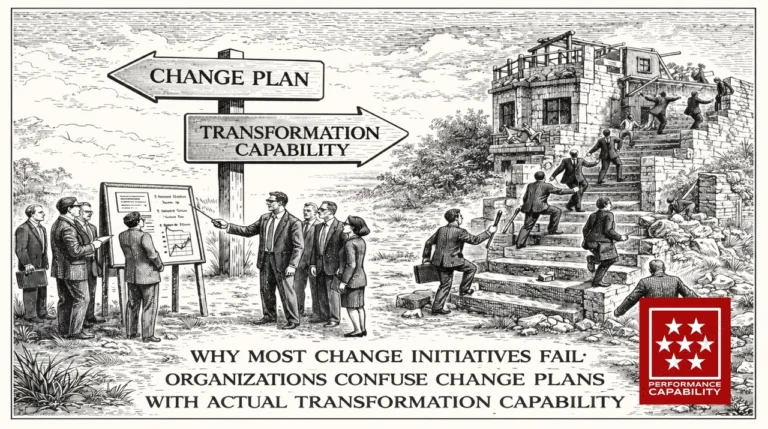
Most established businesses approach business model innovation with the same fatal assumption: that a brilliant model, properly executed, will generate sustainable profitability. They study disruptors, hire consultants, run design sprints, and emerge with elaborate blueprints for transformation. Then they fail.
The failure isn’t in the model itself. It’s in the unstated premise that underlies the entire exercise—that strategic design precedes organizational capability. In reality, the relationship works in reverse. Your business model cannot sustainably generate profits beyond what your organizational capabilities can defend.
This isn’t a matter of execution discipline or change management. It’s a fundamental misunderstanding of how profitability actually works in competitive markets.
The Profitability Ceiling
Every organization has a profitability ceiling determined not by its business model, but by its capability architecture. You can redesign revenue streams, pricing mechanisms, and value propositions all you want. If your organization lacks the specific capabilities required to deliver and defend that model, the market will compress your margins back down to the level your capabilities can sustain.
Consider the established business that decides to “innovate” by moving upmarket—targeting higher-value customers with premium offerings. The model looks compelling on paper. Higher prices, better margins, more profitable customers. But what actually happens?
The sales team lacks the consultative skills to engage C-suite buyers. Marketing produces the same tactical campaigns that worked for transactional products. Service delivery follows standardized processes that high-value customers experience as inflexible. Within eighteen months, the business either retreats to its original market or watches premium competitors defend their territory effortlessly.
The business model didn’t fail. The capability gap did.
The Competition Illusion
Most strategic frameworks push established businesses toward “differentiation”—finding unique positioning relative to competitors. This creates an exhausting cycle of feature comparison, pricing adjustments, and messaging refinement. Everyone claims to be different. No one captures sustainably higher margins.
The real opportunity isn’t found in competing more cleverly within existing market boundaries. It’s found in developing capabilities so distinct that you operate in functional isolation—serving customers in ways competitors cannot replicate without fundamental organizational reconstruction.
This isn’t about offering different features. It’s about being organizationally capable of different things.
When an established logistics company develops genuine predictive capability—using real-time data integration and algorithmic optimization to prevent problems customers don’t yet know they have—they’re not competing with other logistics companies. They’re competing with customer ignorance. The value isn’t in moving things faster or cheaper. It’s in eliminating an entire category of business risk.
That’s not differentiation. That’s capability-based isolation.
The Value Innovation Trap
The innovation literature loves “value innovation”—creating step-change improvements in customer value while reducing cost. It sounds perfect. Higher value, lower cost, irresistible proposition.
But here’s what actually happens: Established businesses identify the value innovation opportunity, design the model, then discover they lack the capabilities to deliver it. So they do what established businesses always do—they approximate. They deliver 60% of the value innovation while maintaining 90% of the cost structure. They call this progress. The market calls it uncompetitive.
Real value innovation doesn’t come from clever business model design. It comes from capability deployment that makes current trade-offs obsolete.
Look at what this means practically. Traditional trade-offs exist because organizations lack the capabilities to transcend them. You offer either customization or scale, either premium quality or cost leadership, either personal service or operational efficiency. These aren’t strategic choices. They’re capability constraints that businesses dress up as positioning.
The established business that genuinely innovates its business model is the one that builds capabilities allowing it to deliver what competitors consider mutually exclusive. They don’t choose between customization and scale. They develop modular design capabilities and flexible production systems that make the choice unnecessary.
The Three Capability Layers
Profitable business model innovation requires capability development across three distinct organizational layers, each with different time horizons and transformation dynamics.
1. Transactional Capabilities: These are the baseline operational competencies—delivery, quality control, customer service, financial management. Most established businesses optimize these endlessly while treating them as commodities. This is backwards. Your transactional capabilities determine your permission to play. If you can’t execute basic operations reliably at competitive cost, no business model innovation saves you.
But here’s the catch: Transaction excellence doesn’t generate innovation advantage. It generates the stability required to develop higher-order capabilities without operational collapse.
2. Transformational Capabilities: These are the adaptive competencies—product development, market sensing, organizational learning, process redesign. This is where most “innovation” budgets get deployed. Established businesses build innovation labs, hire transformation consultants, launch agile initiatives.
Yet transformational capability without purpose is just expensive motion. You need to know what you’re transforming toward, and why your customers should care. That requires the third layer.
3. Transcendental Capabilities: These are the meaning-making competencies—understanding deep customer motivation, identifying emerging need structures, recognizing patterns before they become obvious. This is where breakthrough business models originate.
Most established businesses never develop transcendental capabilities because they’re not obviously transactional. You can’t measure them in quarterly reviews. They don’t show up in process maps. But they’re what allow certain organizations to see opportunities that competitors literally cannot perceive.
The profitable business model innovation happens when all three layers work in concert. You perceive an opportunity others miss (transcendental), you build organizational responses before competition emerges (transformational), and you execute with reliability that builds customer confidence (transactional).
Miss any layer, and your business model innovation becomes another expensive failed initiative.
The Established Business Advantage
Here’s what nobody tells you: Established businesses have an inherent advantage in capability-based innovation. They have customer relationships, operational infrastructure, institutional knowledge, and financial resources. Their problem isn’t resource scarcity. It’s capability lock-in.
Your current business model generated your current capabilities. Those capabilities now constrain what business models you can successfully pursue. This creates an organizational trap: The more successful your current model, the more deeply embedded your existing capabilities, the harder it becomes to develop genuinely different ones.
Breaking this trap doesn’t require abandoning your core business. It requires building new capability architectures in parallel with existing ones—not as experiments or “innovation theaters,” but as legitimate organizational commitments with dedicated resources and protected development time.
The established business that successfully innovates its business model is the one that treats capability development as the primary strategic investment, and business model design as the natural expression of organizational capability.
The Profitability Reality
Sustainable profitability comes from two sources: operational excellence in established capabilities, and premium capture from distinctive capabilities. Business model innovation only generates the second type of profitability when it’s grounded in genuine capability development.
This changes everything about how you approach innovation. You don’t start with market analysis or customer interviews. You start with organizational capability assessment. What can your organization actually do that competitors cannot replicate? What capabilities could you develop that would make current competition irrelevant? What capability gaps prevent you from capturing value your customers clearly need?
The business model that emerges from this analysis won’t look like a “pivot” or a “transformation.” It will look like the logical expression of what your organization has become uniquely capable of delivering.
That’s when business model innovation generates sustainable profitability: when it’s not innovation at all, but evolution—the natural expansion of what your organizational capabilities now make possible.
The truth about business model innovation: It doesn’t create profitability. Organizational capability creates profitability. Business model innovation is just what we call it when capability development reaches sufficient maturity to serve markets in fundamentally different ways.
Stop designing business models and start building capabilities. The profitable models will emerge on their own.
Thanks for reading this post. I hope you gained some value from it. Please sign up below and you will join my community for updates and live events. You can also find my main business at: www.benson-speaks.com www.performancecapability.com
© Ben Benson