The Change Initiative Paradox: The Menu is Not the Meal
Organizations don’t fail at change because they lack good plans. They fail because they mistake the plan for their own performance capability.
Walk into any organization six months after a major change initiative and ask two questions: “Did you implement the new system?” and “Can you operate differently?” The first question will receive confident affirmation, complete with documentation, training records, and rollout timelines. The second question will produce hesitation, qualification, and a growing list of reasons why the actual transformation “needs more time.”
This capability gap between declared implementation and executable outcomes reveals the fundamental flaw in how organizations approach transformation: they confuse the representation of change with the experience of change. They’ve mastered the paperwork of transformation while the actual capability to operate differently remains undeveloped.
The AT/AU Balance in Change Management
Every change initiative operates at two distinct levels: the Approach in Theory (what the organization says it’s doing) and the Approach in Use (what the organization can actually execute). The distance between these two approaches determines whether transformation succeeds or becomes another abandoned initiative added to the organizational graveyard.
Consider the typical enterprise system implementation. The Approach in Theory includes comprehensive training programs, detailed process documentation, change management communications, and executive sponsorship. The project plan shows green. The steering committee receives positive updates. The system goes live on schedule.
The Approach in Use tells a different story. Users revert to workarounds because the new process conflicts with how work actually flows. Exception handling—which represents 40% of actual work—wasn’t addressed in the standard operating procedures. The promised efficiency gains vanish as people spend time navigating the gap between system design and operational reality. Within months, the organization has an implemented system that nobody can truly operate.
The change was completed. The transformation never occurred.
Principle 5: Understanding Reality in Transformation Context
Distinguish Between Experience and Representation of Experience
Organizations routinely substitute representations of change for the experience of change. They confuse:
- Communication about change with understanding of change
- Attendance at training with developed capability
- Documented processes with executable processes
- Executive commitment with organizational capacity
- System deployment with operational proficiency
- Change project completion with transformation achievement
Each substitution creates a dangerous illusion: the organization believes transformation has occurred because the representations of transformation are in place. The PowerPoint deck shows the new operating model. The intranet site houses the process documentation. The training completion rates hit 98%. The project status is green.
But representations are not reality. They are descriptions of reality. And the critical insight is this: you cannot execute a description.
The Menu Is Not The Meal
Consider a restaurant analogy. The menu describes the meal. It uses vivid language and detailed descriptions. It may even include photographs. But you cannot eat the menu. The description of the meal, no matter how accurate or comprehensive, cannot satisfy hunger.
Organizations attempting transformation consistently make this error. They create elaborate descriptions of the transformed state—strategy documents, operating models, process maps, organizational charts, value statements. They communicate these descriptions extensively. They train people on these descriptions. They measure people’s familiarity with these descriptions.
Then they wonder why nothing actually changes.
The menu is not the meal. The change plan is not the capability. The documented process is not the executed process. The training program is not the developed skill. The communication cascade is not the understood reality.
Transformation requires the actual meal—the practiced, repeatable, sustainable capability to operate differently. This capability develops through commitment-based action over time, not through exposure to accurate descriptions of desired future states.
Why Change Initiatives Confuse Implementation with Transformation
The substitution of representation for reality serves a purpose: it’s much easier to create representations than to develop capabilities.
Writing a new process takes weeks. Developing the organizational capability to execute that process takes months or years. Communicating a new strategic direction takes days. Building the capacity to operate in that direction takes sustained, sequential effort. Documenting new values takes hours. Embedding those values into organizational behavior patterns takes commitment-based action across extended timelines.
Organizations face pressure to show progress. Representations provide visible, measurable progress. “We’ve trained 500 people this month.” “We’ve documented all critical processes.” “We’ve communicated the change to the entire organization.” Each statement is true. Each statement suggests progress toward transformation. None addresses the actual question: Can we execute differently?
The confusion deepens because representations can create the subjective experience of progress. People feel informed after a communication campaign. They feel trained after a workshop. They feel aligned after reading the new strategy document. The organization experiences motion, activity, investment.
But subjective experience of progress is itself a representation. It describes the feeling of movement toward transformation. It is not the same thing as the capability to perform transformed operations.
The Sequential Nature of Transformation Capability
Sustainable organizational transformation follows the same principles as individual capability development—it builds sequentially and cannot be accelerated beyond the organization’s capacity to absorb and integrate new ways of operating.
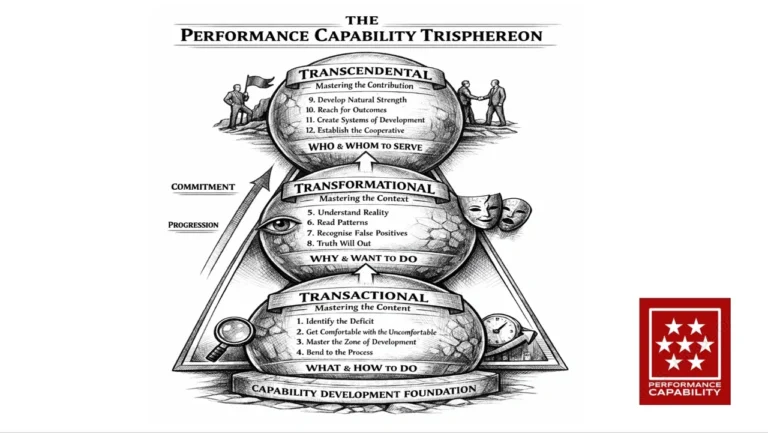
Level One: Transactional – Mastering the Content
Before an organization can operate differently, it must first acknowledge the gap between current capability and required capability (Principle 1: Identify the Deficit). Most change initiatives skip this step entirely. They assume that because senior leadership understands the need for change, the organization accepts it. They confuse intellectual agreement with capability acknowledgment.
The organization must then engage with the uncomfortable reality that developing new capability requires sustained effort through difficulty (Principle 2: Get Comfortable with the Uncomfortable). Change initiatives that promise “seamless transition” or “minimal disruption” deny this reality. They create expectations that directly conflict with what capability development actually requires.
True transformation demands that the organization work within its zone of direct development (Principle 3), not attempt quantum leaps to idealized future states. This means acknowledging current capacity and building incrementally from there, regardless of what the competitive environment or strategic plan demands.
Finally, the organization must bend to the process of capability development (Principle 4). Results take time to measure. The gap between implementing new systems and developing capability to operate those systems plays out over quarters and years, not weeks and months. Organizations that measure transformation success at implementation completion guarantee disappointment.
Level Two: Transformational – Mastering the Context
Even when organizations execute Level One principles, transformation can still fail if the organization cannot read its own behavioral patterns accurately. The documented values state “innovation” and “collaboration,” but observable behavior patterns reveal risk aversion and siloed operation (Principle 6: Your Behaviour Reflects What You Truly Believe).
The organization must recognize where its current systems create rewards for behaviors that contradict stated transformation goals (Principle 7: Recognize False Positives). Performance management rewards individual achievement while the transformation requires collective capability. Promotion decisions favor established expertise while transformation demands learning capacity. Budget processes reward short-term cost reduction while transformation requires sustained investment in capability building.
Each contradiction between stated transformation goals and operational reality reveals that the organization has not truly changed—it has merely added new descriptions to existing operations.
What Sustainable Transformation Actually Requires
Sustainable organizational transformation requires three fundamental shifts in how change is approached:
First: Subordinate the Change Plan to Capability Reality
The change plan must acknowledge and operate within the organization’s actual capacity to absorb and integrate new ways of working. This means:
- Measuring readiness by current capability, not by urgency of need
- Sequencing transformation to match capacity development, not strategic desire
- Acknowledging that implementation timelines and transformation timelines are not the same thing
- Accepting that you cannot force capability development faster than the organization can build it
Second: Replace Motivation-Driven Change with Commitment-Based Action
Most change initiatives rely on motivation—creating urgency, building burning platforms, celebrating quick wins, maintaining momentum. Each approach depends on sustaining a particular mood or energy level.
Commitment-based action operates differently. It subordinates mood-based decisions to principle-based commitments. The organization commits to doing what it said it would do in developing new capability, regardless of whether people feel motivated, whether quick wins materialize, or whether energy flags.
This shift is critical because capability development includes long periods where visible progress is minimal, where people feel competent in old ways and incompetent in new ways, where the effort feels disproportionate to results. Motivation-driven approaches cannot sustain through these periods. Commitment-based action can.
Third: Measure Transformation by Capability, Not by Implementation
The question “Did we implement the change?” must be subordinated to “Can we execute differently?”
This requires fundamentally different metrics:
- Not “percentage of people trained” but “percentage of people demonstrating new capability”
- Not “process documentation completed” but “process execution consistent and sustainable”
- Not “system deployed” but “operations improved through system use”
- Not “communication delivered” but “understanding demonstrated through action”
The shift feels uncomfortable because capability metrics take longer to show progress, require more nuanced assessment, and cannot be easily manipulated. But they measure what actually matters: whether the organization has developed the capacity to operate differently.
The Commitment Question
Every change initiative ultimately faces a single question: Will the organization commit to doing what it said it would do in developing new capability, regardless of how long it takes, how difficult it becomes, or how motivated people feel along the way?
Most organizations never explicitly address this question. They assume that approving the change initiative, allocating the budget, and launching the program constitutes commitment. They mistake the decision to change for the commitment to develop capability.
But transformation capability develops through sustained action over extended periods, not through decisions and declarations. The organization either commits to this reality or it doesn’t. There is no middle ground, no shortcut, no way to substitute planning for practice.
Organizations that commit to this understanding can achieve sustainable transformation. They still face all the same difficulties, but they face them with accurate expectations and appropriate approaches. They measure progress by capability rather than activity. They acknowledge the gap between implementation and transformation. They build sequentially from current capacity rather than leaping toward idealized futures.
Organizations that don’t commit to this understanding will continue the pattern: another change initiative launched, another set of plans documented, another round of training completed, another implementation declared successful. And six months later, the same question produces the same hesitation: “Did you implement the new system?” Yes. “Can you operate differently?” Well…
The representation of change is not the same as the experience of transformation. Organizations that cannot distinguish between the two will continue to implement change initiatives that fail to transform anything. Organizations that understand this distinction can begin the actual work of developing sustainable organizational capability.
The choice is not whether to change. The choice is whether to confuse the description of change with the capability for change. One documentation, the other produces transformation. One is the plan, the other is the stairs. One is the menu the other is the meal.
Thanks for reading this post. I hope you gained some value from it. Please sign up below and you will join my community for updates and live events. You can also find my main business at: www.benson-speaks.com www.performancecapability.com
© Ben Benson